Social and Emotional Learning
As I sat in a Lower Elementary classroom observing during the morning work cycle, three children surrounded a rug working on a math material.
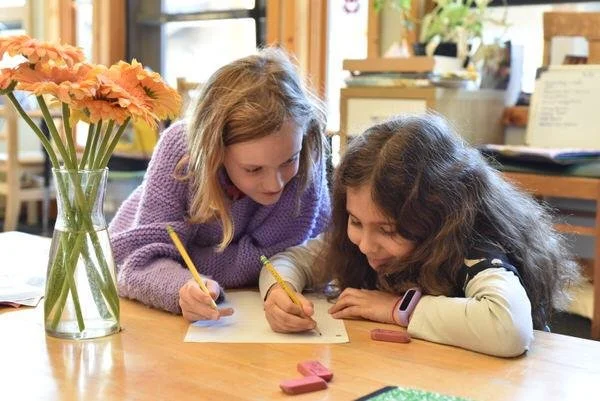
“It is my turn to move the beads on the bead frame,” one student says.“No you went last time, it’s my turn,” says another.
The conversation continues and things escalate a bit, with both students believing their perspective is right. One of the adults comes over when she observes the students struggling and acts as a mediator in support of them resolving their conflict. She doesn't offer them the solution, just helps them take turns in the conversation hearing one another’s perspectives. The students come to an agreement and continue the computation.
The Montessori classroom, known as the Prepared Environment, is thoughtfully created to not only support students in their independent learning of academic subjects but also to learn from the earliest stages what it means to work and live in a community. Opportunities for conflict resolution, understanding the perspective and needs of others, friendships, self-care, and mentors and mentees are all an integral part of their daily life at school – even in the Nido.
As the children mature, they begin to learn the language of feelings and emotions and can express them to others in the moment. There is time to pause when situations arise to work through conflicts in real time. Learning about oneself and others occurs organically throughout the day with adult support when needed. Because of this, children learn what it takes to be in relationships with others in a very authentic way, rather than social and emotional learning as a stand-alone curricular element.
Step into any Montessori classroom and observe. Undoubtedly, you will see countless exchanges where social learning is taking place. Not because it is being explicitly taught, but because it is being experienced and supported.
Read more about how our school supports social and emotional learning on this new page in our Family Portal.